Special Operations
San Mateo County Hazardous Materials Response Team

Team Overview
San Mateo County contracts with San Mateo Consolidated Fire Department to provide countywide hazardous materials coverage through the San Mateo County Hazardous Materials Team, a regional resource that provides specialized mitigation, identification, and decontamination capability across San Mateo County. The team is certified by the California Governor's Office of Emergency Services (Cal OES) as a Type 1 Hazardous Materials Response Team — the highest classification level in the state's tiered system, reflecting the team's capability to respond to the broadest range of chemical, biological, radiological, and unknown-substance incidents.
History
The South County Fire Authority — a joint agency of Belmont and San Carlos — formed the San Mateo County Hazardous Materials Team in 1986, making it one of the first hazardous materials teams in the country. It remains the only hazardous materials team San Mateo County has ever had, continuously operating for nearly four decades under the administration of four successive agencies:
- South County Fire Authority — 1986-2006
- Belmont-San Carlos Fire Department — 2006-2011
- Belmont Fire Department — 2011-2019
- San Mateo Consolidated Fire Department — 2019-present
Through each administrative transition, the team's personnel, mission, and countywide response role have remained continuous, with San Mateo Consolidated Fire Department now serving as the contracting and administering agency.
Funding and Guidance
The San Mateo County Hazardous Materials Team operates under a Joint Powers Authority (JPA) agreement, the contract is renegotiated every three years. The team's current annual operating budget is $951,500. Funding is split evenly: fifty percent is paid by San Mateo County itself, and the remaining fifty percent is divided among the county's 20 cities. This shared-cost model allows every jurisdiction in the county to draw on a Type 1-certified team without any single agency independently bearing the full cost of maintaining that level of training, staffing, and equipment.
Team Composition and Qualifications
The San Mateo County Hazardous Materials Team maintains 35 qualified team members trained and certified to the hazardous materials technician level or higher. Members complete initial technician-level certification and ongoing recurrent training to maintain proficiency and meet Cal OES Type 1 standards, including:
- Chemical, biological, radiological, and unknown-substance identification and mitigation
- Technical decontamination
- Specialized personal protective equipment (PPE) operations
- Air monitoring and detection
Beyond large-scale or high-profile incidents, the team's day-to-day workload covers a wide range of hazardous materials calls throughout San Mateo County, including:
- Chemical spills and leaks at commercial and industrial facilities
- Unknown-substance and suspicious-powder investigations
- Illicit drug lab and fentanyl-exposure responses
- Carbon monoxide and other atmospheric hazard investigations
- Transportation-related releases, including roadway and rail incidents
- Illegal or improperly stored hazardous waste
- Assistance to law enforcement on suspected explosive or unstable material calls
Response Model
SMC Fire's hazardous materials apparatus is housed and staffed at Station 14 in lower Belmont. When a hazardous materials incident exceeds the capability of a first-arriving engine or truck company, the San Mateo County Hazardous Materials Team is dispatched countywide to provide technician-level mitigation. Initial arriving San Mateo County Fire units establish scene control, isolation, and initial hazard assessment while the hazmat team responds to assume technical mitigation duties. As a Type 1 team, the unit is also available for mutual aid deployment beyond San Mateo County when requested through the state's Cal OES mutual aid system.
Urban Search & Rescue CA –TF3 Response & Training

SMC Fire maintains 10 personnel who are deployable members of California Task Force 3 (CA-TF3), one of eight FEMA Urban Search and Rescue (US&R) task forces based in California and one of 28 nationwide. CA-TF3 is sponsored and hosted by the Menlo Park Fire Protection District, which manages the team and prepares it to respond anywhere in California or the United States under FEMA's National Urban Search and Rescue Response System.
How CA-TF3 Works
CA-TF3 was established in September 1991 as an 80-person task force drawn from 18 participating agencies plus civilian specialists, with roughly 220 members available to respond in total. Task force members are firefighters and paramedics, rescue specialists, emergency room physicians, structural engineers, heavy equipment specialists, hazardous materials technicians, canine search teams, and communications and logistics specialists — each trained in one of four core disciplines: search, rescue, technical (structural, hazmat, and logistics support), and medical care.
The team also partners with NASA's Ames Disaster Assistance and Rescue Team (DART), based at Ames Research Center near Mountain View, giving CA-TF3 access to specialized US&R technology that it frequently tests for broader task force use.
Under FEMA's activation model, the three nearest task forces to a disaster are called up first; additional teams mobilize if the scale of the event requires it. Once notified, CA-TF3 is built to deploy within six hours, either as a full Type I task force of about 70 personnel or a lighter Type III configuration of about 28, along with roughly 70,000 pounds of prepackaged search, rescue, and medical equipment.
What They Respond To
Urban search and rescue is a multi-hazard discipline. CA-TF3 is trained and equipped to locate, extricate, and provide initial medical stabilization to victims trapped in confined spaces or structural collapse resulting from:
- Earthquakes and other structural collapse events
- Hurricanes, tornadoes, and severe storms
- Floods and dam failures
- Technological accidents and transportation incidents
- Hazardous materials releases
- Terrorist incidents
The task force has deployed both domestically and internationally, with many SMC Fire personnel involved in those deployments. Including response to Hurricane Iniki in 1992, the 1995 Oklahoma City bombing, search and rescue operations at the World Trade Center following the September 11, 2001 terrorist attacks, debris recovery work following the 2003 Space Shuttle Columbia disaster, response to Hurricane Katrina in 2005, the 2013 Moore Oklahoma tornado, and search operations in Magalia and Paradise following the 2018 Camp Fire.
Funding
CA-TF3 operates under a FEMA cooperative agreement that funds task force equipment, training, readiness, and deployment costs as part of the National Urban Search and Rescue Response System. Menlo Park Fire Protection District, as the sponsoring agency, administers the team and its funding on FEMA's behalf, coordinating the resources contributed by the task force's 18 participating agencies.
Training
CA-TF3 members maintain certification across the four US&R specialty disciplines — search, rescue, technical, and medical — through recurring FEMA-standard training and full-scale exercises, including structural collapse and shoring scenarios. This training keeps the task force at continuous readiness to activate on FEMA's timeline and supports SMC Fire's broader technical rescue capability across San Mateo County.
Water Rescue
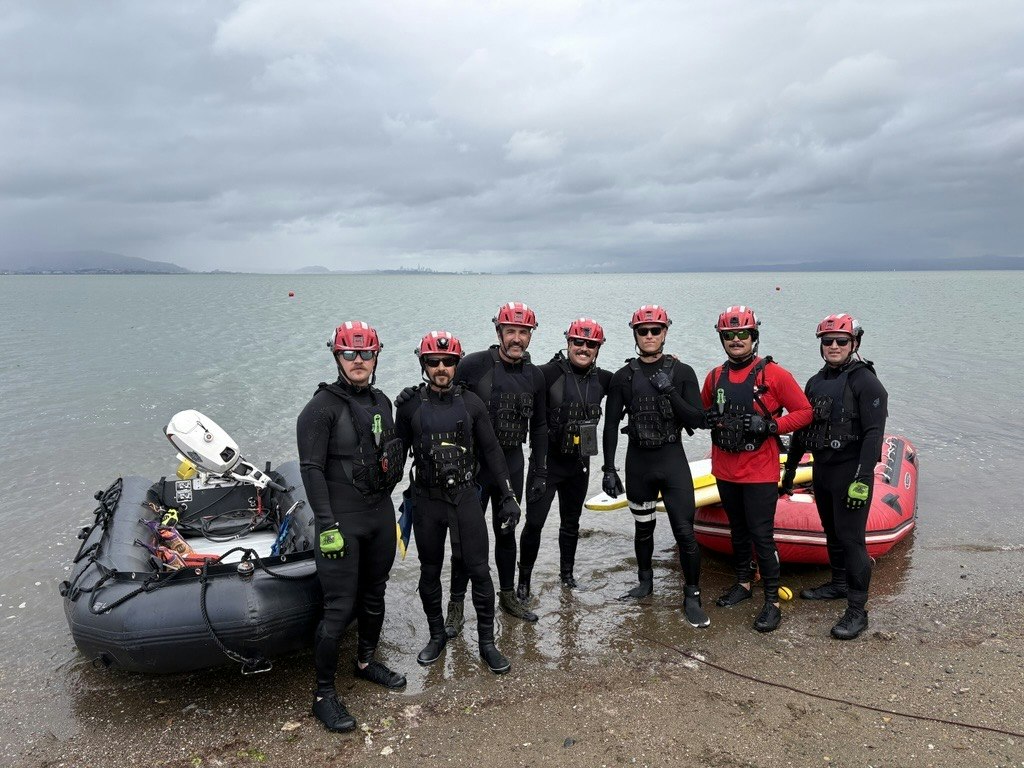
The San Mateo Consolidated Fire Department maintains a team of specially trained personnel dedicated to responding to water rescue emergencies throughout the region. Team members hold state certifications as Rescue Swimmers, Personal Watercraft (PWC) Operators, and Swiftwater Technicians, and are equipped to operate in some of the most demanding marine conditions in the Bay Area.
Coverage Area
SMC Fire responds to water emergencies across:
- The San Francisco Bay
- Inland waterways, lakes, and lagoons throughout San Mateo County
The department serves as the primary water rescue response agency for several high-priority areas, including:
- The waters surrounding the San Mateo–Hayward Bridge
- The waters adjacent to San Francisco International Airport (SFO)
- Heavily trafficked windsurfing and kiteboarding zones
Equipment and Capabilities
The team uses specially designed rescue personal watercraft (PWC) built to navigate the rough, windy, and frequently unpredictable marine conditions found throughout the jurisdiction. This equipment allows crews to reach individuals in distress quickly, even in conditions that would be unsafe for conventional vessels.
Training and Response
Water Rescue team members are trained to:
- Extract individuals from high-risk marine environments
- Render Advanced Life Support (ALS) medical care on scene
- Identify and mitigate hazards on the water
Station and Apparatus
SMC Fire's Water Rescue team is based out of Station 28 in Foster City, which houses the majority of the team's water rescue equipment. An additional trailer stationed at Coyote Point carries supplemental gear to support response efforts. Engines 24 and 26 also provide additional water rescue support for the team.
Regional Partnerships
SMC Fire works closely with local, state, and federal partner agencies to coordinate response efforts and ensure safety across the region's waterways.